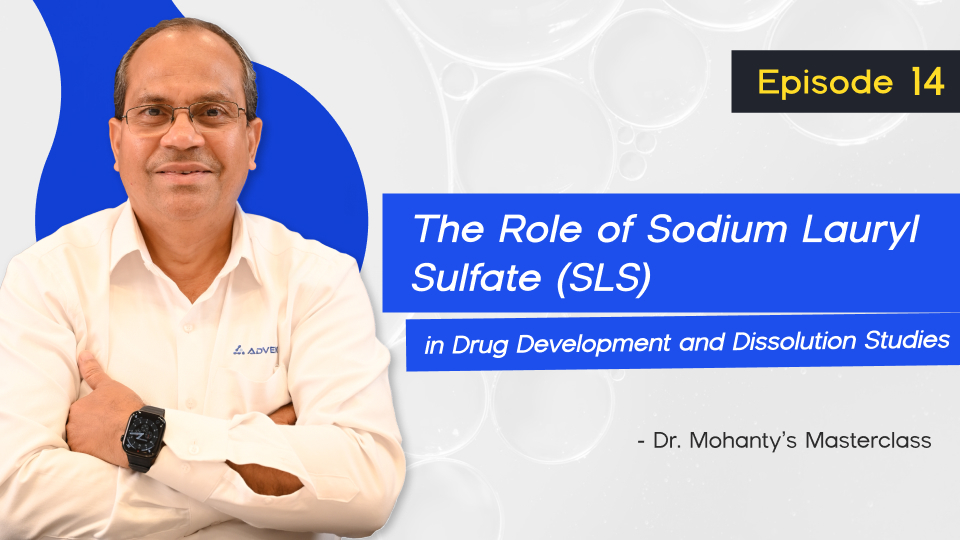
In the world of pharmaceuticals and drug formulation, one of the most crucial components to consider is the bioavailability of a drug—its ability to be absorbed and utilized by the body. A key factor in optimizing bioavailability is ensuring that poorly soluble drugs can dissolve effectively in the digestive tract, where they are absorbed. In Episode 14 of Dr. Rashmi Ranjan Mohanty’s Masterclass, titled "The Surfactant Bridge Between Solubility & Bioavailability", we explore the pivotal role of Sodium Lauryl Sulfate (SLS) in enhancing the dissolution properties of drugs, particularly in the context of BCS Class II drugs.
Dr. Mohanty, a respected leader in the field of Fine and Specialty Chemicals Industry, takes us on a deep dive into Sodium Lauryl Sulfate, a surfactant that plays a fundamental role in the dissolution studies of pharmaceutical formulations. Whether you are a researcher, a formulator, or someone involved in the analytical testing of drugs, understanding SLS and its applications can make a significant difference in how drug formulations are designed for optimal performance in the human body.
What is Sodium Lauryl Sulfate (SLS)?
Sodium Lauryl Sulfate (SLS) is an anionic surfactant, which means that it carries a negative charge in solution. Its primary function is to lower the surface tension between substances, which helps in improving the solubility of drugs, especially hydrophobic (water-insoluble) drugs. The amphiphilic nature of SLS, which means it has both a hydrophobic (water-repelling) and a hydrophilic (water-attracting) component, makes it particularly effective in solubilizing poorly soluble substances in water. This characteristic is critical when we consider the bioavailability of drugs that have limited solubility in the body’s aqueous environments.
The chemical structure of Sodium Lauryl Sulfate includes a 12-carbon hydrophobic alkyl chain (lauryl group) and a hydrophilic sulfate head group with a sodium counter-ion. This structure enables SLS to form micelles, which are aggregates of molecules that help encapsulate and solubilize poorly soluble drugs, making them more bioavailable. The formula for SLS is C12H25SO4Na, and its molecular weight is 288.38.
The Importance of SLS in Dissolution Studies
The dissolution of drugs is a critical step in the pharmacokinetic process, as it influences how quickly and efficiently the drug is absorbed into the bloodstream. The dissolution profile of a drug is often tested during its development to determine how it will behave once it is ingested and exposed to the fluids in the gastrointestinal (GI) tract. For BCS Class II drugs—those that are poorly soluble but highly permeable—ensuring that they dissolve effectively is essential for their therapeutic efficacy.
Sodium Lauryl Sulfate is used in dissolution studies primarily because of its ability to mimic the surfactant conditions of the GI tract. In the stomach, there are naturally occurring surfactants that help break down and solubilize food and other substances. By using SLS in dissolution studies, researchers can simulate these conditions in the lab, providing a more biorelevant and reproducible testing environment.
SLS also plays a significant role in enhancing wettability and dispersion of hydrophobic drugs. When drugs are poorly soluble, they tend to aggregate or clump together, reducing their surface area and thus their ability to dissolve. SLS helps by breaking apart these aggregates and dispersing the drug particles more uniformly, allowing for a faster dissolution rate. In dissolution studies, typical concentrations of SLS range from 0.25% to 2%, depending on the specific requirements of the study and the nature of the drug being tested.
Why Purity Matters: Impurities in Commercial SLS
While Sodium Lauryl Sulfate is an incredibly effective surfactant, the purity of the SLS used in drug formulation and dissolution studies is of utmost importance. Commercial SLS may contain impurities such as sodium sulfate, alcohols, and hydrocarbons, which can negatively impact its performance in scientific studies.
These impurities can affect key properties such as surface tension and critical micelle concentration (CMC), leading to baseline noise during High-Performance Liquid Chromatography (HPLC) or UV analysis. For accurate and reliable data, it is crucial to use high-purity SLS that does not contain significant levels of these contaminants.
ADVENT, a leader in the supply of high-purity SLS, offers several grades of Sodium Lauryl Sulfate tailored for different applications. These include SLS AR Grade (≥99%), SLS HPLC Grade (≥99%), and SLS HPLC Premium Grade (≥99.5%). These grades are specifically designed to provide minimal unsulfonated matter and controlled sodium sulfate, ensuring the integrity of dissolution studies and other analytical tests. They also come batch-tested for consistent performance, ensuring reproducibility in critical scientific analyses.
ADVENT’s High-Purity SLS Grades
ADVENT’s high-purity grades of Sodium Lauryl Sulfate offer a range of benefits, especially for those working with analytical applications that require the highest level of purity and precision:
SLS AR Grade (≥99%): Suitable for general quality control (QC) and dissolution media. This grade is ideal for routine applications where standard purity is sufficient.
SLS HPLC Grade (≥99%): Designed for high-end analytical needs, this grade is specifically formulated to minimize impurities that could interfere with analytical instruments such as HPLC.
SLS HPLC Premium Grade (≥99.5%): This ultra-pure grade is for advanced analytical applications, ensuring the lowest levels of UV-absorbing impurities and consistent surfactant performance.
Each of these grades is tested for consistent CMC and surfactant performance, ensuring that they meet the stringent requirements of modern pharmaceutical and analytical research.
Analytical and Physical Properties of SLS
Sodium Lauryl Sulfate is typically supplied as a white to off-white crystalline powder or flakes that are freely soluble in water and ethanol. When dissolved in water, SLS forms a solution with a pH range of 7-9 for a 1% solution.
One of the key attributes of SLS is its surface tension and conductivity, which can be used to confirm the quality of the product. These characteristics are essential for ensuring that the surfactant is functioning as expected in dissolution and other laboratory applications.
Applications Beyond Dissolution
While SLS is primarily known for its role in dissolution studies, it has a wide array of applications across various scientific fields:
SDS-PAGE Electrophoresis: SLS is used in laboratory techniques such as SDS-PAGE (Sodium Dodecyl Sulfate Polyacrylamide Gel Electrophoresis) for separating proteins based on their size.
Emulsification and Wetting Agent: SLS acts as an effective emulsifier in cosmetics and pharmaceuticals, aiding in the uniform dispersion of oil and water-based formulations.
Cleaning Validation: SLS is also used in cleaning validation procedures to remove residues from equipment used in the pharmaceutical industry.
Versatile Analytical Reagent: Beyond its surfactant properties, SLS is used as a reliable reagent in various analytical tests and formulations, showing its versatility as a chemical compound.
Conclusion: A Dependable Surfactant for Modern Pharmaceutical Research
In conclusion, Sodium Lauryl Sulfate (SLS) is an indispensable tool in the pharmaceutical and analytical sciences. Its ability to enhance solubility, improve bioavailability, and ensure reproducibility in dissolution studies makes it a critical component in the development of new drug formulations. Furthermore, with high-purity grades like those offered by ADVENT, researchers can rely on SLS for accurate and consistent results in both dissolution studies and a variety of other analytical applications.
As Dr. Mohanty’s Masterclass Episode 14 illustrates, the importance of purity cannot be overstated. By using high-purity SLS, scientists can ensure that their experiments are free from interference, allowing for better decision-making in drug development and improving the efficacy of new treatments.
The versatility and reliability of SLS make it a cornerstone in modern pharmaceutical research, driving the development of effective, safe, and bioavailable drugs that benefit millions worldwide. Dr. Mohanty’s insights not only deepen our understanding of Sodium Lauryl Sulfate but also highlight its vital role in achieving consistent and reproducible scientific outcomes.