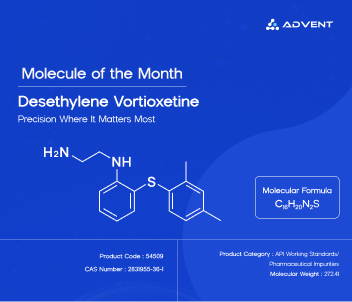
In pharmaceutical development, the molecule you don't see on the final label often matters as much as the one you do. Impurities, intermediates, and metabolites define the quality, safety profile, and regulatory readiness of every API that reaches a patient. Among these, Desethylene Vortioxetine (CAS No. 2831955-36-1) has emerged as one of the more strategically significant reference standards in the antidepressant drug development space — and for good reason.
What Is Desethylene Vortioxetine?
Desethylene Vortioxetine is a pharmaceutical impurity and structural intermediate closely associated with the synthetic pathway of Vortioxetine, the widely used multimodal antidepressant marketed under the brand name Trintellix. Chemically identified as N1-(2-((2,4-Dimethylphenyl)thio)phenyl)ethane-1,2-diamine, it carries the molecular formula C₁₆H₂₀N₂S and a molecular weight of 272.41 g/mol.
Structurally, this molecule represents a key diamine intermediate — a fragment that provides critical insight into the synthetic route of Vortioxetine and how the final API is assembled, transformed, and characterized during manufacturing. Its presence in process streams makes it an essential compound to monitor, isolate, and authenticate.
Why Does It Matter in Pharmaceutical Development?
The pharmaceutical industry is held to increasingly exacting standards by regulatory bodies such as the FDA, EMA, and ICH. Impurity profiling is not an optional exercise — it is a regulatory requirement embedded across ICH Q3A, Q3B, and Q6A guidelines. For any drug substance derived from a complex synthetic sequence, having qualified reference standards for each known impurity and intermediate is non-negotiable.
Desethylene Vortioxetine occupies a particularly important position in this framework. As a structurally defined diamine derivative, it allows manufacturers to:
Confirm API identity and structural integrity during synthesis
Monitor for its presence or absence as a quality indicator at key process checkpoints
Develop and validate HPLC-based analytical methods for impurity quantification
Conduct forced degradation studies to assess API stability under stress conditions
Build a compliant regulatory dossier supported by well-characterized reference data
Without a reliable, high-purity reference standard for this molecule, analytical laboratories would be navigating Vortioxetine process development essentially blind to one of its most relevant impurities.
Advent's Approach: Precision at Every Scale
At Advent, Desethylene Vortioxetine has been successfully synthesized and developed at scales ranging from milligrams to grams — a critical capability for a compound that serves both exploratory research applications and large-scale QC programmes.
The emphasis throughout development has been on three pillars: purity, structural integrity, and analytical reliability. The product is manufactured to a minimum purity of NLT 95% (not less than 95%) by HPLC, with batch-to-batch consistency verified through a comprehensive characterization suite. Each lot undergoes advanced analysis using:
HPLC — for purity determination and impurity profiling
Mass Spectrometry (MS) — for molecular weight confirmation and structural elucidation
Infrared Spectroscopy (IR) — for functional group identification
¹H NMR — for structural confirmation and integrity assessment
This multi-technique approach ensures that every batch released is not just analytically characterized but scientifically credible — meeting the rigorous standards expected by pharmaceutical manufacturers, CMOs, and independent analytical laboratories.
Applications Across the Development Lifecycle
Desethylene Vortioxetine from Advent is suitable for use across the full span of pharmaceutical development activities:
Method Development: Establishing robust HPLC methods requires well-characterized reference compounds. This molecule provides the anchoring standard for developing gradient conditions, system suitability parameters, and detection wavelengths specific to Vortioxetine-related substances.
Method Validation: ICH Q2(R1)-compliant validation requires specificity, linearity, accuracy, precision, and detection/quantitation limits — all of which depend on reliable reference standards. Desethylene Vortioxetine supports this process with documented analytical data.
Impurity Profiling: During routine batch analysis and stability testing, the ability to quantify and track this impurity over time provides manufacturers with early warning indicators of process drift or degradation events.
Forced Degradation Studies: Stress testing under conditions of heat, humidity, light, acid, and alkali generates degradants whose profiles must be characterized. This molecule may emerge as a relevant degradation product in such studies, making its reference standard essential for accurate identification.
Routine QC: Ready-stock availability and consistent batch data make this compound a dependable addition to analytical laboratory inventories handling Vortioxetine API or dosage form testing.
Ready Stock. Reliable Data. Real-World Readiness.
Advent currently holds this molecule in ready stock, with prompt delivery capability — a practical advantage in a supply environment where reference standard delays can hold up regulatory submissions and manufacturing schedules. A Certificate of Analysis (CoA) with potency data is provided with every lot.
For pharmaceutical manufacturers navigating the complexity of Vortioxetine development, or analytical laboratories expanding their working standard library, Desethylene Vortioxetine from Advent offers a combination of scientific rigour and commercial reliability that is difficult to replicate.
To enquire or request a quote, visit www.adventchembio.com or contact the Advent team directly.