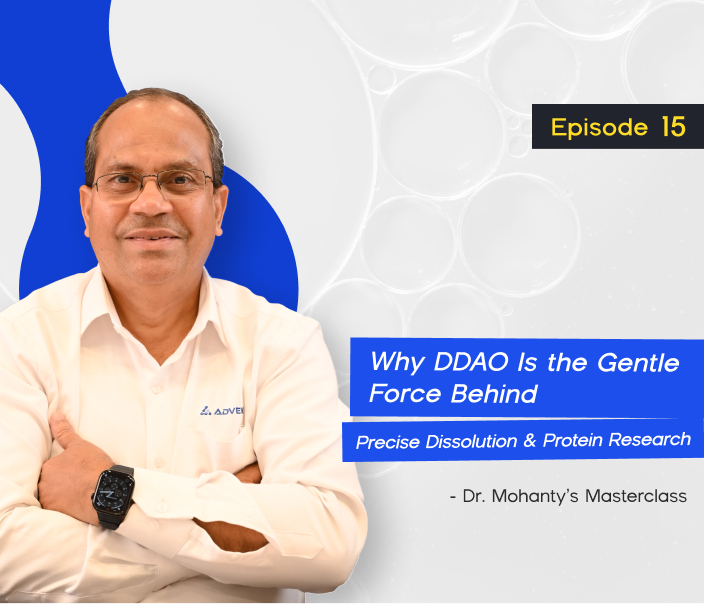
In modern pharmaceutical and biophysical research, analytical accuracy depends not only on sophisticated instruments or complex methodologies, but equally on supporting excipients that quietly govern system behavior. Among these, surfactants play a decisive role—especially in dissolution testing, solubilization studies, and membrane protein research.
One such molecule that has steadily gained prominence is N,N-Dimethyldodecylamine N-oxide (DDAO), also known as LDAO. Often described as mild, non-denaturing, and biocompatible, DDAO offers a rare balance between effective solubilization and molecular gentleness.
In this edition of Dr. Mohanty’s Masterclass, we explore the chemistry, functionality, and real-world relevance of DDAO—and why high-purity DDAO (>99%) supplied by ADVENT has become a trusted choice for leading pharmaceutical and research organizations across India for more than a decade.
Chemical Structure & Physicochemical Identity
DDAO is a tertiary amine oxide surfactant with the molecular formula C₁₄H₃₁NO. Structurally, it consists of:
A 12-carbon hydrophobic alkyl chain, providing lipid affinity
A polar amine oxide head group, responsible for water solubility

This structural duality makes DDAO amphiphilic, enabling it to align efficiently at interfaces and self-assemble into micellar structures.
A defining feature of DDAO is its zwitterionic behavior, which allows it to adapt dynamically to different pH environments:
Under acidic conditions, it exhibits cationic characteristics
Under neutral to alkaline conditions, it behaves predominantly as a nonionic surfactant
This pH-responsive versatility gives DDAO a functional advantage across diverse analytical systems, buffers, and formulation environments. Importantly, high chemical purity (≥99%)—as provided by ADVENT—is essential to maintain this delicate balance and ensure predictable performance.
Surfactant Behaviour: Controlled Activity Without Aggression
DDAO is recognized for its efficient yet controlled surface activity. Unlike harsh ionic detergents, it offers:
Significant surface tension reduction
Micelle formation at low concentrations, with a CMC typically in the range of 1–2 mM
Mild, non-denaturing behavior, preserving structural integrity of sensitive molecules
Broad compatibility with anionic, cationic, and nonionic surfactants
This combination makes DDAO particularly valuable in formulations and analytical systems where over-aggressive detergency can distort results or damage biomolecules.
Role of DDAO in Pharmaceutical Dissolution Studies
Dissolution testing remains a cornerstone of pharmaceutical development, quality control, and regulatory compliance. However, poorly soluble or hydrophobic APIs often pose challenges in achieving reproducible and biorelevant dissolution profiles.
DDAO plays a critical role in such systems by acting as a wetting and solubilizing agent within dissolution media.
Key Contributions of DDAO in Dissolution Testing:
Enhances wetting of hydrophobic API surfaces
Improves dissolution rate of poorly soluble compounds
Reduces variability between test runs
Maintains uniform dispersion throughout the dissolution medium
Stabilizes hydrodynamic and solubilization conditions
By minimizing fluctuations and inconsistencies, DDAO helps establish robust, reproducible dissolution environments, which is particularly important during:
Batch-to-batch comparison
Formulation optimization
Bioequivalence and stability studies
In essence, DDAO contributes quietly but decisively to analytical confidence and regulatory defensibility.
DDAO vs Sodium Lauryl Sulfate (SLS): A Practical Comparison
Sodium Lauryl Sulfate (SLS) has traditionally been a go-to surfactant for dissolution studies. However, its strong anionic nature can sometimes be a limitation rather than an advantage.
For formulations involving sensitive molecules, charged APIs, or complex excipient matrices, DDAO offers superior compatibility and system stability.
DDAO in Biophysical & Biochemical Research
Beyond pharmaceutical testing, DDAO has earned a strong reputation in biophysical and biochemical research, particularly in membrane protein studies.
Membrane proteins are notoriously difficult to handle due to their hydrophobic nature. DDAO provides a solution by:
Solubilizing lipid membranes effectively
Preserving the native structure and functionality of proteins
Avoiding denaturation during extraction and purification
As a result, DDAO (commonly referred to as LDAO in research literature) is widely used in:
Protein crystallization studies
Structural biology
Photosynthetic complexes
Membrane-bound enzymes
Few surfactants achieve this balance of solubilization efficiency and molecular preservation.
Broader Applications Beyond the Lab
DDAO’s functional versatility extends into multiple industries:
Personal care formulations such as shampoos and cleansers, where mildness and foam stability are critical
Stability in oxidizing systems, including hydrogen peroxide-based formulations
Mild antimicrobial activity at higher concentrations
Use in cell lysis buffers, biosurfactant research, and surface chemistry models
This broad applicability highlights DDAO’s role as a multi-functional specialty surfactant, rather than a single-use laboratory reagent.
Safety, Handling & Storage
While DDAO is mild in application, it should be handled with standard laboratory precautions:
Avoid direct contact with skin and eyes
Use gloves and protective eyewear
Store in tightly sealed containers
Keep away from strong acids and oxidizers
Maintain dry storage at room temperature
The ADVENT Advantage
For over a decade, ADVENT has been supplying DDAO with purity exceeding 99%, ensuring:
Consistent surfactant behavior
Reliable analytical outcomes
Batch-to-batch reproducibility
The product is available in 100 g, 500 g, and 1 kg packs, with flexible supply options through ADVENT’s sales team and channel partners.
Conclusion: Precision Through Gentleness
In an era where analytical accuracy and molecular integrity are non-negotiable, DDAO exemplifies how gentle chemistry can deliver powerful results.
As highlighted in Dr. Mohanty’s Masterclass, DDAO is not merely a surfactant—it is an enabler of precision, stability, and scientific confidence.