The discovery of nitrosamine impurities in widely used medicines has been one of the most consequential regulatory events of the past decade. Starting with the NDMA contamination of valsartan products in 2018, health authorities worldwide - from the US FDA to the EMA - have fundamentally repositioned nitrosamine risk assessment from a peripheral concern to a central pillar of pharmaceutical quality management. Today, every drug manufacturer must demonstrate not just product efficacy, but also the absence or rigorous control of these potentially carcinogenic trace-level contaminants.
At the heart of this evolving compliance landscape are nitrosamine-specific impurity standards - and few are more analytically critical right now than N-Nitroso Maprotiline.
Understanding N-Nitroso Maprotiline
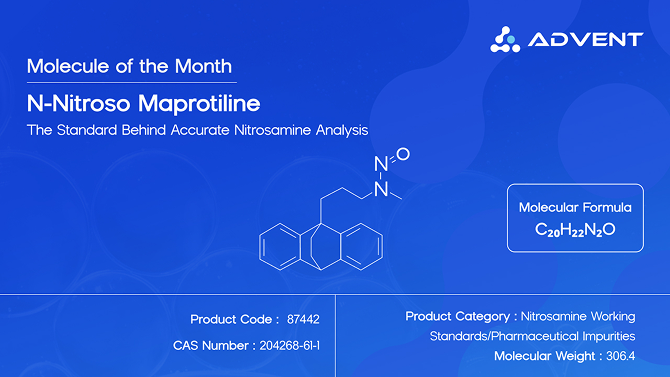
N-Nitroso Maprotiline (CAS No. 204268-61-1), chemically identified as N-Methyl-N-nitroso-9,10-ethanoanthracene-9(10H)-propanamine, is the principal nitrosamine impurity associated with Maprotiline - a tetracyclic antidepressant used in the treatment of major depressive disorder and anxiety. The molecule carries a molecular weight of 306.4 g/mol and is represented by the molecular formula C₂₀H₂₂N₂O.
Like other nitrosamines in its class, N-Nitroso Maprotiline arises when secondary amines present in active pharmaceutical ingredients or excipients react with nitrosating agents - nitrite impurities, nitrogen oxides, or degradation by-products - under the right conditions of pH, temperature, and moisture. In the case of Maprotiline-containing formulations, this makes N-Nitroso Maprotiline a foreseeable and regulatorily significant process-related impurity.
Critically, while its occurrence may be trace-level, the toxicological implications are not. Regulatory agencies classify many nitrosamines as probable human carcinogens under ICH M7 guidelines, and acceptable intake (AI) limits for such compounds are set at parts-per-billion or even sub-ppb levels - demanding analytical methods of exceptional sensitivity and precision.
The Regulatory Imperative
Since 2021, the FDA and EMA have made nitrosamine impurity testing non-negotiable for both new and existing drug products. ICH M7(R2) guidelines, EMA's nitrosamine guidance, and the FDA's control strategy recommendations form a layered regulatory framework that demands proactive risk assessments, root cause analysis for any detected nitrosamine, and validated test methods with formally established limits.
For Maprotiline-containing products specifically, N-Nitroso Maprotiline must be identified as part of the nitrosamine risk assessment exercise, and any confirmed risk must be supported by validated analytical methods. Without a reliable certified reference standard - one with confirmed structural identity, high purity, and documented analytical performance - laboratories simply cannot develop or validate the methods required to meet these regulatory expectations.
ADVENT's Role: Precision Where It Matters
This is where Advent’s work on N-Nitroso Maprotiline becomes strategically significant. Advent has successfully synthesised N-Nitroso Maprotiline as a high-purity Nitrosamine Working Standard, purpose-built to serve the exacting needs of pharmaceutical manufacturers, contract research organisations (CROs), and independent analytical laboratories.
The material has been comprehensively characterised using four orthogonal analytical techniques:
HPLC - for purity determination and chromatographic profiling
MS - for structural confirmation critical for nitrosamine detection
IR Spectroscopy - for functional group identification and structural fingerprinting
NMR Spectroscopy (¹H NMR) - for definitive structural elucidation
Each batch is supported by a Certificate of Analysis (CoA) and full spectral data documentation, ensuring full traceability and regulatory defensibility in laboratory records.
Applications Across the Analytical Workflow
N-Nitroso Maprotiline from Advent is engineered for versatility across the pharmaceutical quality continuum:
Method Development: Creating robust, sensitive analytical procedures for trace nitrosamine detection in Maprotiline drug substance and drug product
Method Validation: Establishing and documenting key performance parameters including specificity, linearity, LOD, LOQ, accuracy, and precision as per ICH Q2(R2)
Impurity Profiling: Systematic identification and quantification of all potential nitrosamine impurities across the product lifecycle
Routine Quality Control: Ongoing batch release testing to ensure each production lot meets defined nitrosamine limits
Regulatory Submission Support: Providing validated data packages required by health authorities during NDA, ANDA, and MAA filings
Why Reliable Standards Are Non-Negotiable
In nitrosamine testing, the quality of the reference standard directly determines the quality of the test result. A standard with uncertain purity introduces systematic error at the calibration step - meaning that even the most sophisticated LC-MS/MS setup will yield unreliable quantification. Pharmaceutical laboratories cannot afford this uncertainty. Every result connected to patient safety must be traceable, defensible, and reproducible.
Advent's established expertise in nitrosamine impurity standards - developed through years of focused investment in synthesis, analytical infrastructure, and regulatory know-how - positions it as a trusted partner for laboratories navigating this demanding compliance environment.
Ready to Support Your Programme
N-Nitroso Maprotiline is currently available as a ready-stock item, enabling prompt dispatch to meet project timelines. For technical specifications, sample requests, CoA access, or collaborative method development discussions, the Advent team is available to engage directly.
As the regulatory bar for nitrosamine control continues to rise, having the right analytical standards in place is not just good laboratory practice -it is a regulatory requirement and a patient safety obligation.